Launched on May 19, 2015, INC is a global collaboration formed to forge a predictable regulatory path for advancing the safety and effectiveness of therapies for neonates across the world.
Overview
The Problem
More than 96% of neonates receive at least one off-label medication while in the neonatal intensive care unit (NICU). Off-label medications are a normal part of patient care, however their use results in more adverse drug reactions in NICU patients. For medications to be used on-label, or to be indicated, for a specific patient population, they must first be rigorously studied in that population. Unfortunately, designing drug trials in neonates is extremely difficult. There is a persistent unmet need for safe and effective products specifically catering to and studied in neonatal populations.
The Solution
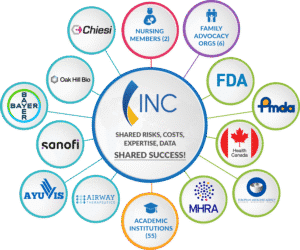
C-Path launched the International Neonatal Consortium (INC) in order to address this unmet need. This global public-private partnership is designed to create a predictable regulatory pathway for evaluating the safety and efficacy of therapies for neonates. INC unites stakeholders from hospitals, research institutions, drug developers, patient advocacy groups, regulatory agencies, and other organizations around the world to generate consensus and develop tools that accelerate medical innovation for neonates.
Through open collaboration in a noncompetitive format, teams share data, knowledge, and expertise, in order to advance medical innovation and regulatory science for this underserved population.
The Impact
INC and its partners have developed guidelines to inform the design of rigorous and efficient clinical trials for potential treatments of neonatal seizures. Neonatal seizures are the most common neurological emergency in neonates, occurring in about 3 in 1,000 term live births, and are associated with significant mortality and neurodevelopmental disability. Trials for this condition are exceedingly difficult and face many challenges, including different diagnostic criteria in different countries, relative rarity in occurrence and the self-limiting nature of many neonatal seizures, which can make them difficult to capture in the setting of a controlled study.
As a result of INC’s work, consensus recommendations were developed and published to address vital aspects of neonatal seizure clinical trials, including considerations for alternative designs, inclusion and exclusion criteria, safety monitoring, appropriate outcome measures, analytical plans and more.
Neonatal Drug Development Resources
Interested in reviewing resources developed by the Institute for Advanced Clinical Trials for Children (I-ACT)? Click here.
Real-World Data Analytics Platform
With the support of FDA’s Office of Medical Policy, INC has initiated an ambitious real-world data integration effort, which will greatly accelerate drug development in neonates. Building on C-Path’s expertise in data integration, analysis, model-informed drug development (MIDD), and regulatory submissions, this effort has already integrated more than 300,000 patient-level data points (Electronic Health Records, registries, clinical trials) and is currently focused on:
Constructing a quantitative disease progression model for bronchopulmonary dysplasia
Establishing generalizable neonatal laboratory value reference ranges by age, gender, ethnicity, and other patient-level characteristics
Data integration activities from additional sources are ongoing. The Real-World Data and Analytics Program (RW-DAP) is scalable. The MIDD process is disease agnostic. Upcoming use cases will address industry needs by leveraging RW-DAP to establish historical controls for a range of neonatal diseases. The existing data are already capable of supporting other neonatal disease areas.
For additional questions or information, contact the INC team here.
Projects, Working Groups and Platforms
INC’s Real World Data Efforts: Advancing Neonatal Drug Development
At the International Neonatal Consortium (INC), we are committed to leveraging Real World Data (RWD) to drive advancements in neonatal drug development. Our Real-World Data Analytics Platform (RW-DAP) enables the integration, analysis, and application of diverse datasets to inform clinical decisions, streamline research, and foster innovative therapeutic solutions for neonatal care.
Our Data Ecosystem
INC has established a robust infrastructure to gather and curate neonatal data from multiple sources, including:
Electronic Health Records (EHRs): Data from 17 hospitals and 5 international sites.
Registries and Observational Studies: Comprehensive datasets to support real-world evidence (RWE) generation.
Collaborations: Partnerships with leading institutions like CHOP, Tufts, and Lurie Children’s Hospital.
To date, we have engaged with over 65 contributors and executed 30 Data Contribution Agreements (DCAs). Our data collection efforts are largely disease-agnostic, encompassing a wide range of neonatal conditions to ensure broad applicability across clinical and research needs.
Data Utilization for Neonatal Care
Our RWD efforts are directed at creating actionable insights to enhance neonatal health outcomes. Key initiatives include:
Neonatal Lab Value Reference Ranges: Establishing standard reference intervals through advanced statistical models like refineR.
Predictive Modeling for BPD: Leveraging INC’s Real-World Data Analytics Platform (RW-DAP) to address critical challenges in Bronchopulmonary Dysplasia (BPD), a devastating complication of prematurity. With no new approved therapies in over 30 years, our efforts focus on:
Trial Simulations for Clinical Efficiency: Using RWD to simulate clinical trials, optimize designs, and create historical external controls.
These efforts aim to improve survival rates, reduce long-term complications, and address the unmet needs in BPD care, which contribute significantly to healthcare costs. While initially focused on BPD, the tools and insights generated are designed to be disease-agnostic, enabling broader applications across neonatal drug development.
The Future Vision
Our RW-DAP initiative envisions a future where neonatal care is transformed through data-driven insights and innovative solutions:
Scalable Model-Informed Drug Development (MIDD): The MIDD process we employ to create Drug Development Tools (DDTs) is inherently adaptable. By leveraging our largely disease-agnostic data collection, this process can be easily applied to other neonatal disease areas, fostering innovation and efficiency across the spectrum of neonatal drug development.
AI-Powered Analytics: Harnessing machine learning to detect patterns and predict outcomes.
Accessible Data Platforms: Ensuring that curated data supports global research and regulatory needs.
Impact on Neonatal Drug Development
INC’s RWD initiatives are shaping the future of neonatal care by:
Empowering regulatory science with robust data tools.
Personalizing treatment strategies through biomarker discovery.
Enhancing clinical trial efficiency with predictive models.
Promoting equitable healthcare outcomes by including diverse patient demographics.
Join the Collaboration
Contact Us
For more information about our RWD initiatives and how to get involved, please contact us.
Real-World Data in Bronchopulmonary Dysplasia
Addressing Unmet Needs in BPD
Bronchopulmonary Dysplasia (BPD) is a chronic lung disease affecting premature infants, with significant impacts on morbidity, mortality, and long-term outcomes. Despite its prevalence, there are critical gaps in early diagnosis, disease progression measures, and validated clinical endpoints.
The BPD Taskforce is a collaborative public-private partnership (PPP) focused on closing these gaps. By leveraging high-quality EHR data, we aim to create regulatory-ready tools that accelerate therapeutic development and improve outcomes for infants with BPD.
Real-World Data in Cell and Gene Therapy
INC’s Cell and Gene Therapy Workgroup: Advancing Gene Therapy for Early Childhood Introduction
The International Neonatal Consortium (INC) is spearheading efforts in regenerative medicine through its Cell and Gene Therapy Workgroup. This initiative focuses on advancing cell and gene therapies tailored for neonates and early childhood, a critical demographic for interventions aimed at modifying or curing debilitating diseases. These efforts are driven by a collaborative, interdisciplinary approach that addresses the unique challenges of early-life regenerative therapies, including ethical considerations, safety, and long-term impacts.
Mission and Vision
Our mission is to leverage advancements in regenerative medicine, including gene therapies, in-vivo gene editing, and cell therapies, to improve outcomes for neonates and young children. By integrating data, fostering collaboration, and addressing key challenges, the INC Cell and Gene Therapy Workgroup aims to pioneer new standards in therapeutic development for this vulnerable population.
Key Objectives
Comprehensive Data Integration:
Leverage Real-World Data (RWD) from clinical trials, patient registries, and longitudinal studies to inform study designs.
Aggregate and standardize data from diverse sources to create a robust, analyzable dataset for regenerative therapy development.
2. Innovative Drug Development Tools:
Develop safety assessment tools, trial design optimization methods, and advanced modeling solutions tailored for neonatal and pediatric populations.
Address challenges such as small patient populations and dynamic disease progression through innovative approaches.
3. Regulatory and Ethical Considerations:
Ensure compliance with regulatory standards while addressing ethical issues, including informed parental consent and equitable access.
Develop strategies for long-term follow-up and assess safety and efficacy in global trials.
4. Collaborative Engagement:
Foster dialogue among stakeholders, including regulators, patient advocates, industry leaders, and academic researchers, to harness collective expertise.
Promote knowledge sharing through workshops, peer-reviewed publications, and public forums.
Why Focus on Early Childhood?
Gene therapies for conditions requiring early intervention demand careful consideration of the unique physiological, genetic, and developmental characteristics of neonates and young children. These therapies often necessitate:
Safety First: Rigorous assessment of delivery mechanisms like adeno-associated viral (AAV) vectors.
Tailored Solutions: Adapting therapies for diverse patient populations and genetic profiles.
Ethical Practices: Ensuring parental consent, equitable access, and consideration of long-term impacts.
Planned Deliverables
Over a three-year timeline, the workgroup aims to achieve the following:
Data Platform Development:
Integrate and curate RWD from over 340,000 neonatal and pediatric patient records for regenerative therapy research.
2. Advanced Trial Design Strategies:
Utilize RWD to create external historical controls, reducing patient recruitment burdens and enhancing trial efficiency.
3. Regulatory Alignment:
Collaborate with regulatory bodies to ensure the reliability of models and tools for clinical trial designs and therapeutic approvals.
4. Dissemination of Knowledge:
Publish findings on safety, trial design, biomarkers, and ethical considerations to inform future research and regulatory practices.
Impact on Gene Therapy Drug Development
The INC Cell and Gene Therapy Workgroup will significantly impact drug development by:
Accelerating Therapeutic Development: Streamlining clinical trials using innovative designs and robust data.
Enhancing Safety Standards: Addressing risk/benefit assessments and ensuring ethical practices in neonatal populations.
Advancing Precision Medicine: Developing tools for patient stratification and outcome optimization.
Pioneering Long-Term Solutions: Setting new benchmarks for global trials and therapy accessibility
Join the Collaboration
INC welcomes stakeholders from academia, industry, regulatory agencies, and patient advocacy groups to contribute to this transformative initiative. Together, we can redefine the future of cell and gene therapies for early childhood.
Contact Us
For more information about INC’s Cell and Gene Therapy Workgroup, please contact us.
Real-World Data in Neonatal Brain Injury and Hypoxic-Ischemic Encephalopathy Drug Development
Advancing Neonatal Brain Injury and HIE Drug Development Through Data Integration and Targeted Tool Development
Unmet Needs in HIE and Neonatal Brain Injury and the Rationale for a Pre-Competitive PPP
The purpose of this research collaboration is to support the conduct of collaborative, exploratory, pre-competitive research to advance neonatal clinical trials and drug development in HIE. The research is intended to be flexible and adaptive, with specific deliverables evolving over time based on stakeholder input, scientific opportunity, and emerging data.
The overall aim is to better define and validate tools and approaches that can improve the efficiency, feasibility, and regulatory acceptability of interventional trials in neonates with HIE. This includes identifying and modeling prognostic indicators, optimizing patient selection, developing clinically meaningful endpoints, and enhancing the ability to assess early treatment effects.
Planned Research Activities
1. Stakeholder Engagement & Gap Analysis
Promoting multi-stakeholder collaboration, including academic centers, industry sponsors, patient advocacy groups, regulators, and data stewards
Convening expert focus groups and working sessions to align on priority unmet needs, data availability, methodological standards, and regulatory expectations
Conducting structured gap analysis to assess limitations of existing HIE trial designs, current endpoints, and early markers of efficacy
Developing an industry position paper co-authored by Taskforce members to articulate shared challenges, outline the need for improved early markers and trial enrichment strategies in HIE, and propose a roadmap for collaborative solution development and regulatory alignment
2. Data Curation & Integration
Curation and harmonization of high-quality datasets containing neonatal imaging, clinical variables, and linked neurodevelopmental outcomes at 18–24 months or beyond
Updating and expanding the Real-World Data and Analytics Platform (RW-DAP) with curated, structured data relevant to HIE and early brain injury
Accessing and integrating additional de-identified, patient-level data from completed clinical trials, real-world datasets, and academic consortia (e.g., NICHD DASH, institutional repositories)
Ensuring standardization of outcome definitions and alignment across datasets to enable pooled analyses
3. Modeling & Tool Development
Developing and validating prognostic models using early clinical and/or imaging data (e.g., MRI-derived markers) to predict long-term neurodevelopmental outcomes
Constructing clinical trial enrichment tools to support more targeted trial enrollment based on baseline risk profiles
Exploring early biological markers (e.g., MRI-based, EEG, or blood-based) as potential exploratory endpoints for use in early-phase trials
Using simulation frameworks to evaluate how these tools impact trial power, sample size, and efficiency under various design scenarios
Documenting model performance (e.g., AUROC, calibration, subgroup performance) for future regulatory alignment
4. Regulatory Strategy & Tool Advancement
Evaluating potential regulatory pathways for biomarker or tool endorsement through FDA’s Letter of Support, Fit-for-Purpose Initiative, or Biomarker Qualification Program
Defining acceptable Contexts of Use (COU) for tools based on their validated performance, clinical utility, and level of regulatory evidence
Developing a position paper to summarize Taskforce goals, early findings, and a proposed path forward for HIE drug development tools
5. Communication & Dissemination
Publishing peer-reviewed manuscripts to share methodology, model results, and scientific conclusions
Co-hosting a workshop or public conference to engage external experts, gather feedback, and build consensus across the neonatal research ecosystem
Conclusion
By focusing on a defined but flexible scope, the HIE Taskforce aims to deliver practical, high-impact tools that address critical gaps in neonatal drug development. Through the integration of curated clinical trial and real-world data, structured stakeholder engagement, and targeted modeling efforts, the Taskforce will support the development of tools that are both scientifically robust and aligned with regulatory expectations.
Contact Us
For more information about INC’s Neonatal Brain Injury and Hypoxic-Ischemic Encephalopathy working group, please contact us.
Other Neonatal Drug Development Working Groups and Efforts
Neonatal Pain Workgroup:
Create a roadmap towards establishing a measure that accurately and reproducibly evaluates acute pain in neonates that is capable of being used to support neonatal analgesic drug development
Seizure 2.0 Workgroup
The INC convened a global group of experts to develop consensus recommendations for neonatal seizure trial designs, including:
Neonate-specific adaptive trial designs tailored to their unique physiology.
Guidelines on inclusion/exclusion criteria, safety monitoring, and outcome measures.
A focus on designing trials with reduced sample sizes,incorporating pharmacokinetic (PK) analysis, and randomization methods for accurate data.
Outcome:
These recommendations are a foundation for developing a Master Protocol to evaluate multiple ASDs, facilitating more efficient and ethically sound clinical trials.
The guidelines have advanced regulatory pathways by providing structured methods to improve the safety and efficacy of ASD trials in neonates, potentially leading to better treatments and outcomes for this vulnerable population.
Additional Resources and Tools
Want to access more INC resources, like Neonatal Tools, FAQs, information about annual meetings, and general resources? Click here.
Collaborators
Advocacy Organizations
Courageous Steps
Hope for HIE
March of Dimes
NEC Society
NICU Parent Network
Nurtured by Design
Preemie World
Speaking for Moms & Babies, Inc.
Neonatal Nursing Organizations
Council of International Neonatal Nurses (COINN)
National Association of Neonatal Nurses
Pharmaceutical Industry Members
Airway Therapeutics
Bayer
Chiesi
Oak Hill Bio (OHB)
Sanofi
Government and Regulatory Agencies
European Medicines Agency (EMA)
Health Canada
MHRA (UK) – Medicines and Healthcare products Regulatory Agency
NICHD (National Institute of Child Health and Human Development)
PMDA (Japan) – Pharmaceuticals and Medical Devices Agency
U.S. Food and Drug Administration (FDA)
Academic Institutions
APHP – South Paris University Hospital
BC Children’s Hospital
Boston’s Children Hospital
Brighton and Sussex Medical School
The Canadian Neonatal Network/University of Toronto
Case Western Reserve University School of Medicine
Children’s Hospital at Montefiore
Children’s Hospital of Philadelphia
Children’s Mercy Hospital, Kansas City
Children’s National Medical Center
Cincinnati Children’s Hospital Medical Center
City St George’s
Columbia University Medical Center
Cordelier Research Center, French National Institute of Health and Medical Research, INSERM
Diderot University, Paris
Duke University
Emory University
Erasmus MC-Sophia Children’s Hospital of Netherlands
Great Ormond Street Hospital
Harvard University
Hospital for Sick Children, Toronto, Canada
Imperial College London
Indiana University–Purdue University Indianapolis
Indiana University Health, Riley Hospital for Children
Jackson Memorial Medical Center, Miami
Johns Hopkins University
Karolinska University Hospital
King’s College, London
Kurashiki Central Hospital
Kyorin University
Mount Sinai Hospital
Nagano Children’s Hospital
Nagoya University Hospital
National Center for Child Health and Development, Tokyo
Nationwide Children’s Hospital
Northern Clinical School, The University of Sydney
NorthShore University HealthSystem
Oregon Health & Science University
Osaka City General Hospital
Osaka University
Osaka Women’s and Children’s Hospital
PGG Institute
Poole Hospital NHS Foundation Trust
Queen Mary University of London
Rady Children’s Hospital
Rīga Stradiņš University Hospital, Latvia
Robert Debré University Hospital, Paris
Saint Anna Hospital, Torino
Saint-Pierre University Hospital
Saitama Medical University, Saitama Japan
Samsung Medical Center, Seoul, South Korea
Shinshu University School of Medicine
Showa University
Southern Illinois University School of Medicine
St. Marianna University School of Medicine
St. Louis Children’s Hospital
Stanford University
SUNY Downstate Medical Center
The Ottawa Children’s Research Institute
Thomas Jefferson University
Tokyo Women’s Medical University
Tufts Medical Center
Uniformed Services, University of the Health Sciences
University College Cork
University College London Hospital
University Hospital Agostino Gemelli, Rome
University Hospital of Brooklyn
University Medical Center Freiburg
University Medical Center Utrecht
University of Arizona
University of Birmingham
University of California, Davis
University of California, San Diego
University of California, San Francisco
University of Colorado
University of Florida
University of Gothenberg, Sweden
The University of Iowa
University of Leuven
University of Liverpool
University of Lübeck
University of Maryland
University of Michigan
University of Montreal
University of North Carolina at Chapel Hill
University of Oklahoma Sciences Center
University of Otago, Christchurch
University of Oxford
University of Siena, Italy
University of Tartu, Estonia
University of Texas Southwestern Medical Center
University of Ulm
University of Utah
University of Washington
University of Wurzburg, Germany
University of Zurich
Vereniging van Ouders van Couveusekinderen (VOC)
Vermont Oxford Network
Yonsei University College of Medicine
Team
Co-Directors
Jonathan Davis
Professor of Pediatrics, Tufts University
Deb Discenza
Founder and CEO, PreemieWorld
Jennifer Degl
Speaking for Moms and Babies, Inc
Wakako Eklund
Advance Neonatal Solutions. L.L.C.
Carole Kenner
Chief Executive Officer, Council of International Neonatal Nurses, Inc. (COINN)
Thomas Miller
VP and Global Head, Pediatrics, Bayer
Mark Turner
Senior Lecturer in Neonatology, University of Liverpool
Thank you for helping us expand participation in this important work! We rely on people with lived experience of ALS to help ensure research reflects the needs and priorities of the community. Please use the form below to nominate someone whose experiences, perspectives, and interests may make them a strong contributor to an ALS Research Working Group. No scientific or medical background is required.