
Global Regulatory Endorsements
Regulatory endorsement is a critical milestone in the development of drug development tools, providing confidence in their scientific validity and suitability for a defined purpose. These endorsements help reduce regulatory uncertainty, promote consistency, and establish a foundation for more efficient drug development and regulatory decision-making.
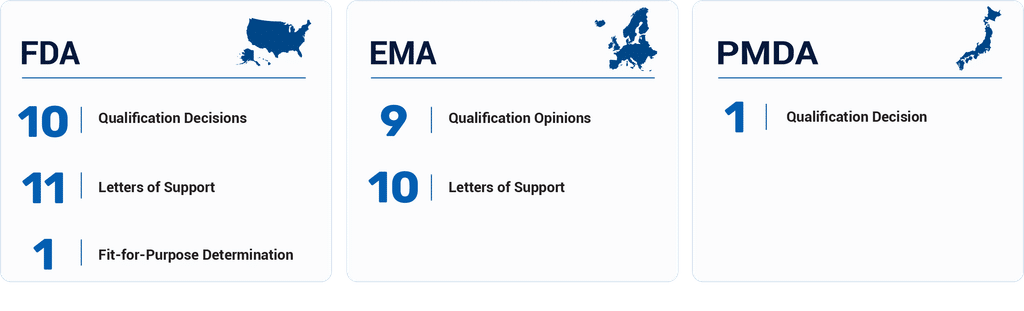
C-Path has a strong track record of successfully obtaining regulatory endorsements from agencies such as the Food and Drug Administration (FDA) and European Medicines Agency (EMA) and the Pharmaceutical and Medical Device Agency (PMDA), demonstrating its leadership in advancing innovative, scientifically supported tools that address critical challenges in drug development.

2026: PROMIS® Short Form Fatigue 10a in Rheumatoid Arthritis
2025: Safety Biomarker to Assess Drug-induced Liver Injury
2020: Diary of Irritable Bowel Syndrome Symptoms – Constipation (DIBSS-C)
2019: Asthma Daytime Symptom Diary (ADSD) and Asthma Nighttime Symptom Diary (ANSD)
2018: Non-Small Cell Lung Cancer Symptom Assessment Questionnaire (NSCLC-SAQ)
2017: Symptoms of Major Depressive Disorder Scale (SMDDS)
2024: Alpha-Synuclein Seeding Amplification Assay
2023: Multiple Safety Biomarkers for Monitoring Pancreatic Injury
2016: Multiple Biomarkers of Drug-Induced Renal Tubular Injury
2016: Multiple Safety Biomarkers for Monitoring Drug-Induced Vascular Injury
2016: Multiple Liver Safety Biomarkers
2015: Molecular Neuroimaging Biomarker: Dopamine Transporter (DAT)
2015: Magnetic Resonance Imaging Biomarker: Low Baseline Hippocampal Volume
2015: Multiple Safety Biomarkers for Monitoring Skeletal Muscle Injury
2015: Multiple Safety Biomarkers for Monitoring Skeletal Muscle Injury
2022: Model-based Clinical Trial Simulation Platform (CTSP) for Duchenne Muscular Dystrophy
2018: Model-Based CT Enrichment Tool for CTs in aMCI
2017: Glutamate Dehydrogenase, a Biomarker of Hepatocellular Liver Injury
2017: Drug-Induced Vascular Injury (DIVI) Biomarker
2016: Drug-Induced Renal Tubular Injury Biomarker(s)
Regulatory Impact
Regulatory endorsement is an important milestone, but the true value of a drug development tool lies in its practical application. C-Path helps develop and advance tools that enable researchers and drug developers to better understand diseases, identify appropriate patients for clinical trials, and generate evidence to support regulatory decision-making. The following examples illustrate how C-Path’s contributions have translated into practical applications that help accelerate drug development, facilitate regulatory review and bring new therapies to patients.
Total Kidney Volume (TKV) measures kidney size and can help identify people with ADPKD who are more likely to experience disease progression. C-Path, through the PKD Outcomes Consortium (PKDOC), helped bring together patient data, standardize those data, and develop the disease model used to support regulatory qualification of TKV. FDA and EMA endorsed TKV as a prognostic biomarker for selecting patients for clinical trials. TKV has subsequently been used in drug development, including to help determine when an experimental treatment was not working so a trial could be stopped early.
Islet Autoantibodies (AAs) are markers in the blood that can help identify people who are more likely to progress to symptomatic type 1 diabetes. C-Path’s Type 1 Diabetes Consortium (T1DC) brought together stakeholders and patient-level data from several studies and developed and validated a model using islet AAs and other patient characteristics. EMA qualified islet AAs as enrichment biomarkers, giving researchers a regulatory-endorsed way to identify people most appropriate for prevention clinical trials.
The Friedreich’s Ataxia Integrated Clinical Database (FA-ICD) brings together clinical trial and natural history data so researchers can better understand what normally happens to people with Friedreich’s ataxia over time. C-Path worked with the Friedreich’s Ataxia Research Alliance to create the database, execute data-sharing agreements, and standardize the data so they could be used for research and regulatory purposes. Data from the resource were subsequently used in an analysis that contributed to the totality of evidence supporting FDA approval of omaveloxolone, the first therapy for FA, demonstrating how existing patient data can help answer important questions in rare-disease drug development.
The Myelofibrosis Symptom Assessment Form (MFSAF) v4.0 provides a consistent way to measure symptoms that matter to people with myelofibrosis. Previously, different clinical trials were using different versions of symptom questionnaires. C-Path’s PRO Consortium established a working group and brought together patients, FDA, drug companies, clinical experts, and measurement experts to develop a single, harmonized questionnaire. The MFSAF v4.0 is now listed in FDA’s Clinical Outcome Assessment Compendium and has been licensed for use in more than 50 clinical trials.
The Alpha-Synuclein Seed Amplification Assay (α-syn SAA) can detect abnormal alpha-synuclein, a protein associated with Parkinson’s disease and related disorders, potentially helping researchers study disease before significant symptoms appear. C-Path’s Critical Path for Parkinson’s consortium brought together stakeholders, reviewed available research and data, prioritized α-syn SAA for advancement, evaluated evidence from observational studies and clinical trials, and engaged with FDA. FDA issued a Letter of Support encouraging further use and study of α-syn SAA, helping stimulate additional data sharing and use of the biomarker in research and clinical trials.
The Hollow Fiber System of Tuberculosis (HFS-TB) is a laboratory model that can help researchers determine which TB drug combinations and doses are most promising before they are tested in people. C-Path’s Critical Path to TB Drug Regimens initiative identified HFS-TB as a promising tool, evaluated evidence supporting its predictive ability, and worked with FDA and EMA to advance its regulatory acceptance. EMA formally qualified the model, providing drug developers with an additional tool to select drugs and doses, improve clinical trial design, and reduce reliance on animal studies.
