
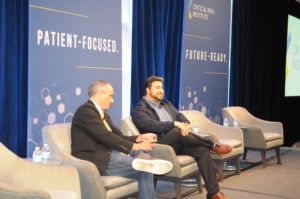
Wednesday at #CGIC2026 closed out the conference with a focus on data sharing, patient voices, and emerging technologies. Milad Alucozai of Pamir Ventures and C-Path CEO Klaus Romero kicked off the morning by exploring how high-fidelity datasets can reshape biomedical innovation. Milad set a powerful tone right out of the gate, challenging the room to use these tools to bring true equity to the rare disease space: “I hope that more of the community that focuses on rare diseases are able to have the same opportunities as those with a larger population disease. So, I think the way we answer that is we have these high-fidelity data sets that are built out in a way that allows us to really get personalized.”
The conversation quickly shifted to maximizing the value of existing tools. A multi-stakeholder panel explored how biomarkers can be repurposed across both safety and disease applications. FDA’s Michael Pacanowski spoke to the ongoing efforts within the Biomarker Data Repository: “We need to work on making data reusable, and we need to think very deliberately about how we are collecting information for clinical trials.”
The patient voice anchored Wednesday’s conversations. Jessica Morris shared a deeply moving perspective on her journey with SOD1-associated ALS: “I want you to leave this room understanding that behind every clinical endpoint, every trial participant and every data point is a person who is fighting to preserve a life that they love and that patient experience should help shape how we measure success, design trials and develop treatments.”
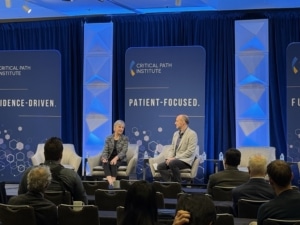
With the patient perspective front and center, former Acting FDA Commissioner Janet Woodcock and C-Path’s Chief Data and Technology Officer Chris Lunt took the stage to evaluate data utility. They explored how teams can prioritize analyses that generate actionable evidence. Woodcock noted the critical role of neutral conveners in this space: “Companies like C-Path and patient groups have stepped into the breach because their mission is to advance therapies. Without them, we’re not going to advance therapies. We’ll stay at the same rate, same failure and so forth.”
Responsible data sharing emerged as an absolute imperative for individualized therapies. Dr. Timothy Yu of Boston Children’s Hospital framed this urgency perfectly: “For several orphan and pediatric neurologic indications, I think it’s useful to look through the lens of data sharing because there are unique constraints and opportunities, ways of rethinking how we think about data sharing not only as a nice to have but as an imperative, an essential component.” Putting that imperative into practice, the conversation shifted to the Rare Disease Cures Accelerator-Data and Analytics Platform and its clinical trial simulation tool for Friedreich ataxia.
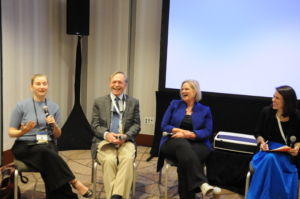
Translating lived experience into regulatory contexts remained a key focus throughout the afternoon. Robyn Bent of the FDA emphasized early integration: “Having the patient voice built in throughout really makes it much easier to consider the patient perspective at the time of regulatory decision-making.” Discussions also covered advancing New Approach Methodologies (NAMs) qualification and leveraging global alignment across C-Path workstreams to support robust endpoints.
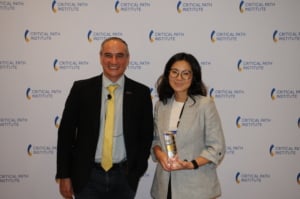
Neuroimaging biomarkers are catalyzing early-stage drug development and biological staging. Qi Guo of AbbVie, receiving the C-Path Data Pioneer Award, captured the collaborative spirit required to move science forward: “I’m honored to receive this award. I think industry needs to make a stronger effort to make data that’s shareable with other academics or other industry partners. Patients get us these images expecting knowledge to be learned, and we should maximize the learning from these images rather than just sitting on individual sponsors.”
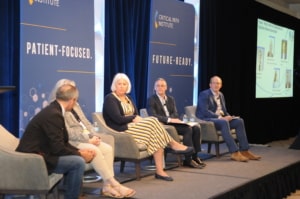
CGIC concluded by looking toward the next evolution of collaboration. Leaders discussed moving beyond individual pilots toward scalable, regulator-aligned platforms. Michelle Campbell of the FDA laid out the path forward during the final session: “I think something that we’ve heard a lot about and where I think there’s a lot of opportunity is the role public-private partnerships play in the future direction of where we’re going in drug development and medical product development.”
That’s an official wrap on #CGIC2026!
The sessions have concluded, but the collaborative work continues. Attendees will soon receive access to on-demand session recordings and post-conference materials to keep the momentum going.
Expect more updates on how these pre-competitive frameworks and public-private partnerships will translate into actionable milestones throughout the rest of the year.
Keep up to date on all these efforts + future initiatives by visiting c-path.org


