

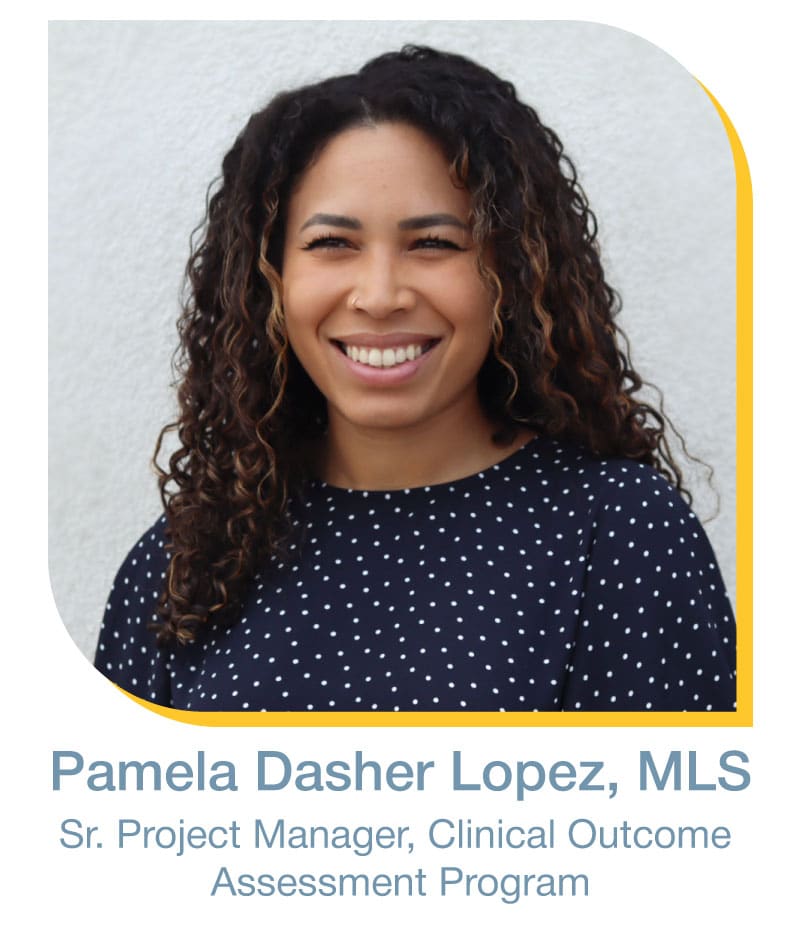
“We all know what happened in March 2020,” Pamela Dasher Lopez stated. She was in Sydney then, managing research portfolios at Macquarie University, when COVID closed the borders and sent her home to Tucson, where she had grown up and earned a bachelor’s in international studies at the University of Arizona. By September, she was back at Critical Path Institute, where she had begun her career in 2011 as a clinical research intern.
Between the internship and her return, Lopez spent nearly seven years in foreign aid, based outside Washington in Bethesda, Maryland. She managed malaria prevention campaigns and projects across Ethiopia, Ghana, Madagascar, Zimbabwe, and South Africa, then led Zika prevention in the Caribbean. She hired country teams, supported regional trainings, and led a $600 million contract proposal. Her first assignment back at C-Path was with the CURE Drug Repurposing Collaboratory, a partnership with the FDA and NCATS that collects real-world data on existing drugs that might treat something other than what they were approved for: drug-resistant infections, neglected tropical diseases and rare cancers. She served as project manager for the program for nearly three years.
“Working at C-Path and learning the intricacies of regulatory science drew me to want to learn more about this area,” Lopez said. She enrolled in the University of Arizona Regulatory Science Certificate and finished in 2022.
“I expected to take some interesting courses, but I did not expect the caliber and depth of the classes,” she explained. The technical topics turned out to be the fun part, the material she really wanted to dive into.
Studying the translational and regulatory pathways, the route a compound takes from a laboratory finding, to an approved medicine, gave her, in her words, an appreciation for how much effort and how many resources go into drug development.
“This experience felt relevant and collaborative, which I was certainly not expecting,” Lopez said. Some of her instructors were C-Path colleagues, the people doing the work they teach. Lopez consistently found herself relating what the U of A courses covered to what C-Path was working on. Her classmates helped too, a mix of people drawn to regulatory science and others coming from adjacent legal specialties.
“The certificate solidified my interest and desire to stay in the field of regulatory science,” she said. “It’s motivated me to continue to find ways to better support C-Path and our work.”
“Being able to pair what I’ve learned from the program with my consortia work, I’ve been able to better develop my strategic thinking and skills in this space,” she explained. Lopez now supports the PCE and eCOA consortia, one consortium working to qualify the assessment tools that measure how people feel and function in their everyday lives as a result of treatment, the other consortium developing the standards and best practices for collecting that data electronically in trials. The Regulatory Science Certificate led Lopez further into the same coursework, and in 2023 she earned a Master of Legal Studies from the University of Arizona.
“If you have any interest in the inner workings of drug development, medical device development, or how regulatory agencies function, then I would absolutely recommend the program,” Lopez said. “It’s niche but so fascinating!”
The University of Arizona Graduate Certificate in Regulatory Science is a fully online, four-course program developed in collaboration with the Critical Path Institute. The program has no entrance exam and can be completed in under a year. Find applications and course details at law.arizona.edu/graduate-certificate-regulatory-science.


