

Wendy Ruyle, Associate Director, Polycystic Kidney Disease Outcomes Consortium
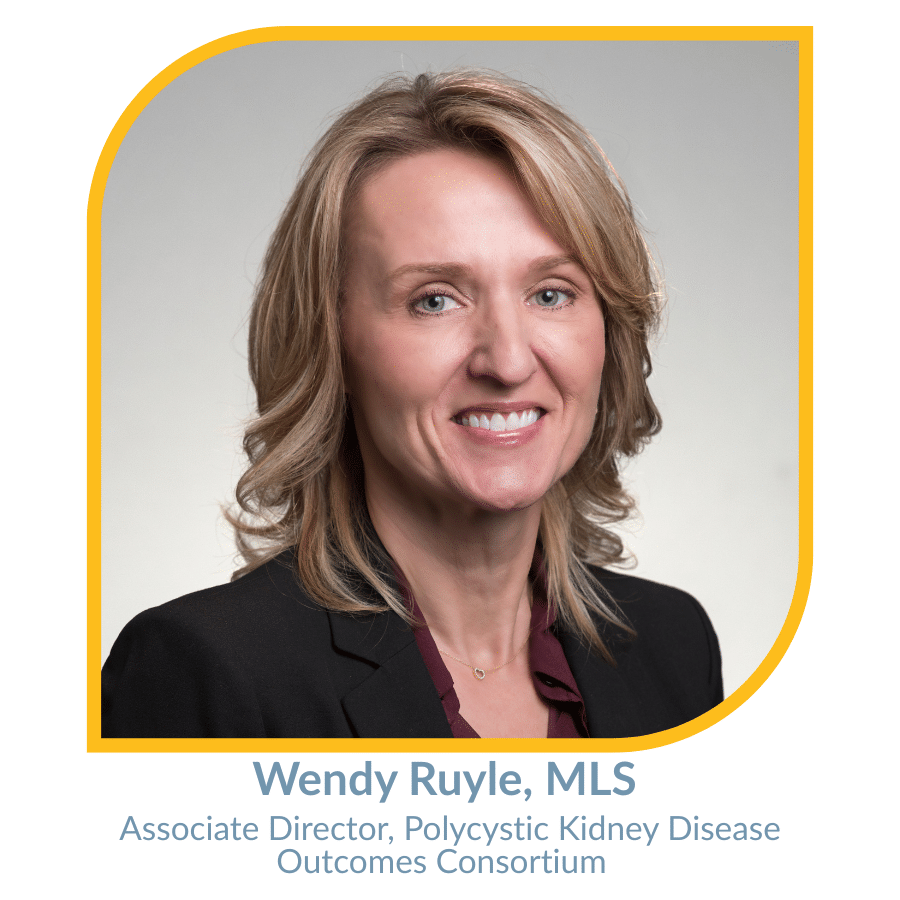
Early in her career, Wendy Ruyle worked as a study coordinator on clinical trials, a role that put her in direct contact with patients. Many of those patients enrolled knowing the drug being tested might do nothing for their own illness. They joined the trial anyway because the results could help future patients. Their willingness to volunteer for a benefit they might never see set the course of her career and, years later, led her to enroll in the Graduate Certificate in Regulatory Science Program at the University of Arizona James E. Rogers College of Law.
“Their commitment and hope for better therapies left a lasting impression on me,” she says. Coordinating those trials taught her that groundbreaking science alone is not enough. A drug that performs in the lab reaches no one until someone qualifies the biomarkers, standardizes the data, builds the clinical outcome measures, and clears the regulatory path. Ruyle decided the part she most needed to master was the law and policy behind that path, so she earned the Regulatory Science Certificate in May 2023 and a Master of Legal Studies the year after.
Ruyle is now Associate Director of the Polycystic Kidney Disease Outcomes Consortium at C-Path, where she works on rare and pediatric kidney disease. She rose through the ranks of clinical research, first as a study coordinator and clinical research associate, then into project and partnership management, and now into a role negotiating with the FDA and international regulators and leading partnerships among industry, academia, clinicians, and patient advocacy groups. Her charge is to build the drug development tools and data standards that make new therapies for polycystic kidney disease possible.
Initially, Ruyle thought the program would teach her to read regulations and handle the legal side of her work. The coursework instead covered the whole landscape of medical product development, including device pathways she had never worked in, and showed her how regulators, industry, academia, and patient organizations drive innovation forward together.
One particular course reframed how she saw regulations: LAW 576A, Drug Discovery, Development and Innovation to Reach the Marketplace. The course covered a product’s full arc, discovery through clinical trials, regulatory review, and post-market study, and reframed regulation for her. Ruyle had thought of regulation as a gate at the end and came to see it as part of how innovation happens. The course also clarified the value of her own work at C-Path, where qualified biomarkers, patient-focused outcome measures, disease progression models, and data standards reduce uncertainty and accelerate development.
Several of her instructors were her own C-Path colleagues, people actively working with the FDA and international regulators while they taught. Because Ruyle was doing the work as she studied it, the two fed each other: a concept from class applied the next day to a real project, and a problem from her job sharpened the next class discussion.
The training changed the questions Ruyle asks. Before, she focused on what was technically possible. Now she asks how it fits the regulatory framework, what evidence would support it, and how regulators, industry, and patients will each read the approach. She can hold her own in strategic conversations about data sharing, intellectual property, and the qualification of drug development tools that she once would have only managed around the edges.
Asked who the program suits, Ruyle does not narrow its value to specialists. She points to anyone who wants to know the “why” behind medical product development, the regulatory and strategic reasoning behind the science. Her one-sentence verdict: the certificate “bridges the gap between science, law, and regulation, providing the knowledge and real-world perspective needed to accelerate innovation and improve the development of therapies for patients.”
The University of Arizona Graduate Certificate in Regulatory Science is a fully online, four-course program developed in collaboration with the Critical Path Institute. The program has no entrance exam and can be completed in under a year. Find applications and course details at law.arizona.edu/graduate-certificate-regulatory-science.


